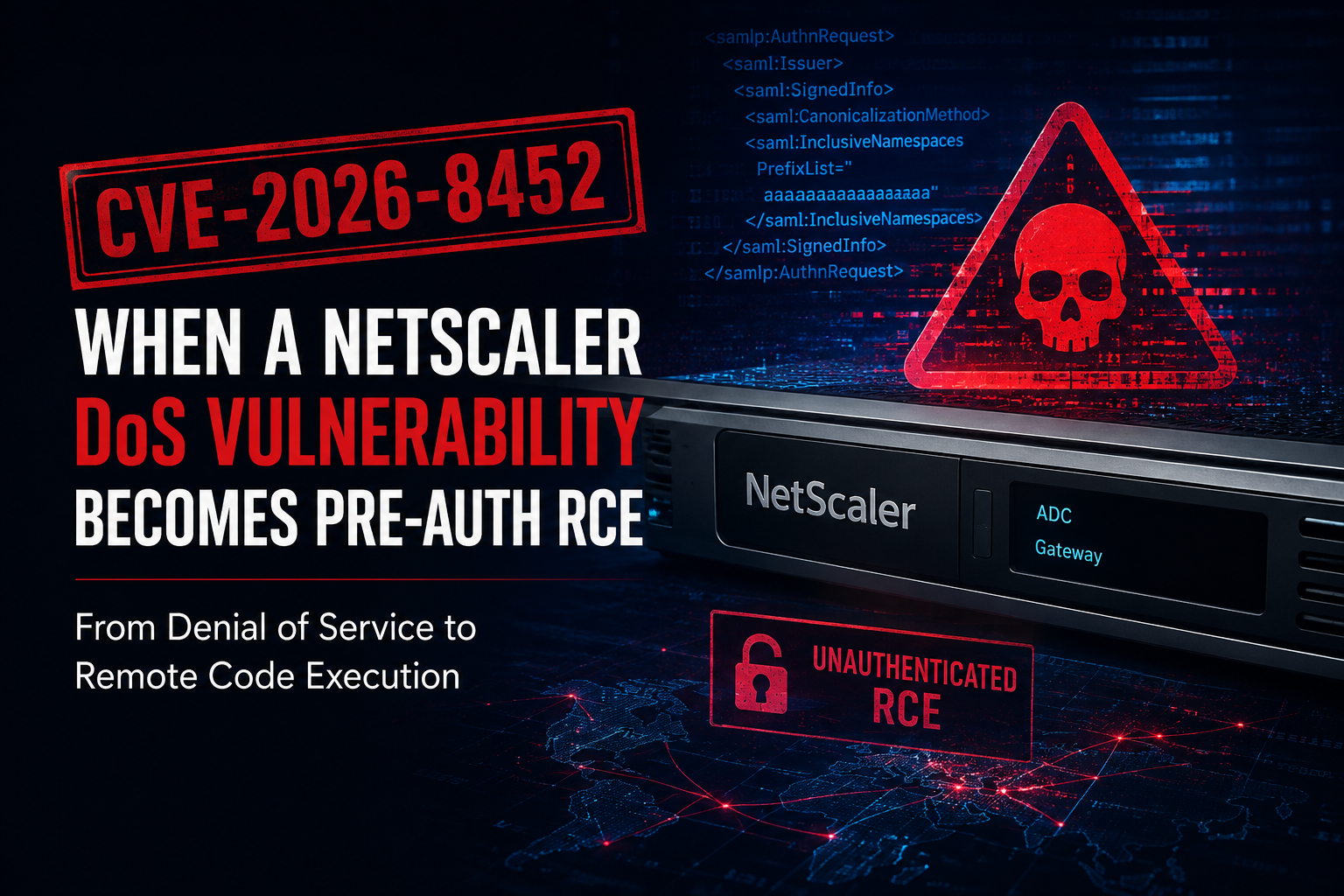
CVE-2026-8452: When a NetScaler DoS Vulnerability Becomes Pre-Auth RCE
When a “Denial-of-Service” Vulnerability Becomes Remote Code Execution: Understanding CVE-2026-8452
Security advisories are designed to help organizations understand risk and prioritize remediation. However, CVE-2026-8452 is a strong reminder that the initial description of a vulnerability does not always represent its full exploitation potential.
CVE-2026-8452 affects NetScaler ADC and NetScaler Gateway appliances and was initially disclosed by NetScaler on June 30, 2026 as a memory overflow vulnerability that could lead to unpredictable behavior or denial-of-service conditions. The vulnerability carries a CVSS v4.0 score of 8.8 and affects systems configured as a Gateway, including SSL VPN, ICA Proxy, CVPN and RDP Proxy deployments, as well as appliances operating as AAA virtual servers.
At first glance, the vulnerability appeared serious but relatively straightforward from a risk-management perspective. Organizations could reasonably interpret the advisory as a service availability issue. Subsequent security research, however, demonstrated that the underlying memory corruption could potentially be transformed into something significantly more dangerous.
Researchers from watchTowr Labs analyzed the NetScaler patch and investigated changes made to the SAML authentication functionality. Their research identified a remotely reachable memory corruption condition during the processing and canonicalization of signed SAML XML data. Specifically, attacker-controlled information contained within the SignedInfo structure could exceed the capacity of a fixed-size memory buffer, allowing data to overwrite adjacent memory structures.
The vulnerability becomes particularly significant because exploitation can occur before authentication. An attacker capable of reaching a vulnerable NetScaler interface does not necessarily require valid credentials or user interaction to trigger the vulnerable functionality.
The research focused on the way NetScaler processes the InclusiveNamespaces PrefixList value during XML canonicalization. By supplying an unusually large attacker-controlled PrefixList, researchers were able to corrupt adjacent heap memory. What initially appeared to be a condition capable of crashing the NetScaler packet-processing engine could therefore be manipulated more precisely.
Through controlled modification of the overflow, the researchers demonstrated that attacker-controlled data could overwrite memory structures used later by the appliance. This eventually provided a write-what-where primitive, effectively allowing controlled data to be written to an attacker-selected memory location.
From there, the research progressed from memory corruption to control of program execution.
The researchers identified a function pointer that could be overwritten through the corrupted heap structures. By redirecting program execution toward attacker-controlled memory, they demonstrated that the vulnerability could ultimately be transformed into unauthenticated remote code execution. Their proof of concept went further by demonstrating the creation of a web shell on the affected appliance.
This dramatically changes the security implications of CVE-2026-8452.
A vulnerability originally communicated primarily in terms of denial of service now represents a potential entry point into one of the most strategically important systems within an enterprise network. NetScaler appliances frequently operate at the perimeter of corporate environments and may provide VPN access, authentication services, application delivery and remote access functionality.
Compromise of such an appliance can therefore provide an attacker with an extremely valuable foothold.
The situation became even more urgent when exploitation activity began to appear outside controlled research environments.
Security organizations subsequently reported attackers attempting to exploit CVE-2026-8452 and deploy web shells on vulnerable NetScaler systems. Observed activity included exploitation attempts originating from multiple countries, including Turkey. Independent telemetry also recorded attempts beginning in August 2026, following publication of public technical research.
On August 26, 2026, the U.S. Cybersecurity and Infrastructure Security Agency added CVE-2026-8452 to its Known Exploited Vulnerabilities catalog, formally recognizing that the vulnerability is being exploited in real-world attacks. U.S. federal agencies were given an August 29 remediation deadline.
The timeline is particularly important.
NetScaler released security updates addressing the vulnerability on June 30, 2026. The affected supported versions include NetScaler ADC and NetScaler Gateway 14.1 releases earlier than 14.1-72.61 and version 13.1 releases earlier than 13.1-63.18. Certain FIPS and NDcPP builds are also affected and require their corresponding updated releases.
Detailed public research demonstrating the remote-code-execution potential appeared on August 14. Exploitation activity was subsequently observed in the wild, and less than two weeks later CISA added the vulnerability to the KEV catalog.
For defenders, CVE-2026-8452 should therefore be treated as considerably more than a conventional denial-of-service issue.
Organizations operating NetScaler ADC or NetScaler Gateway should first establish whether vulnerable versions are still present within their environments and determine whether affected appliances are exposed through Gateway or AAA configurations.
Systems running vulnerable supported versions should be upgraded to the fixed NetScaler releases without unnecessary delay.
Patch deployment alone should also not automatically be interpreted as evidence that the environment was never compromised.
Organizations that operated vulnerable internet-facing appliances during the exposure window should consider conducting retrospective investigation for indicators of compromise. Web-accessible directories should be reviewed for unexpected files, particularly newly created scripts or web shells. Process activity, authentication behavior, system changes and unusual outbound communication originating from NetScaler appliances should also be examined.
Defenders should additionally avoid relying exclusively on crash or reboot events when investigating exploitation.
The vulnerability originates from memory corruption and exploitation techniques may be designed to maintain attacker access without leaving the exact operational symptoms administrators initially expect from a denial-of-service vulnerability. File-system artifacts, process activity, web requests and network telemetry can therefore provide more meaningful evidence than availability logs alone.
There is also a broader vulnerability-management lesson behind CVE-2026-8452.
Severity scores and vendor descriptions are important inputs, but they should not become the only factors determining remediation priority.
Exploitability changes.
Technical research changes.
Public proof-of-concept availability changes.
Threat actor behavior changes.
A vulnerability classified one way on the day of disclosure may represent a fundamentally different operational risk several weeks later.
Modern vulnerability management therefore requires continuous reassessment rather than a one-time decision based on the initial advisory.
CVE-2026-8452 demonstrates this clearly. What began as a high-severity NetScaler memory overflow associated primarily with denial of service evolved into a publicly demonstrated pre-authentication remote-code-execution path and eventually into a vulnerability associated with active exploitation.
For security teams responsible for internet-facing infrastructure, the takeaway is simple.
Do not only ask what the advisory says a vulnerability can do.
Ask what an attacker can actually make it do.