
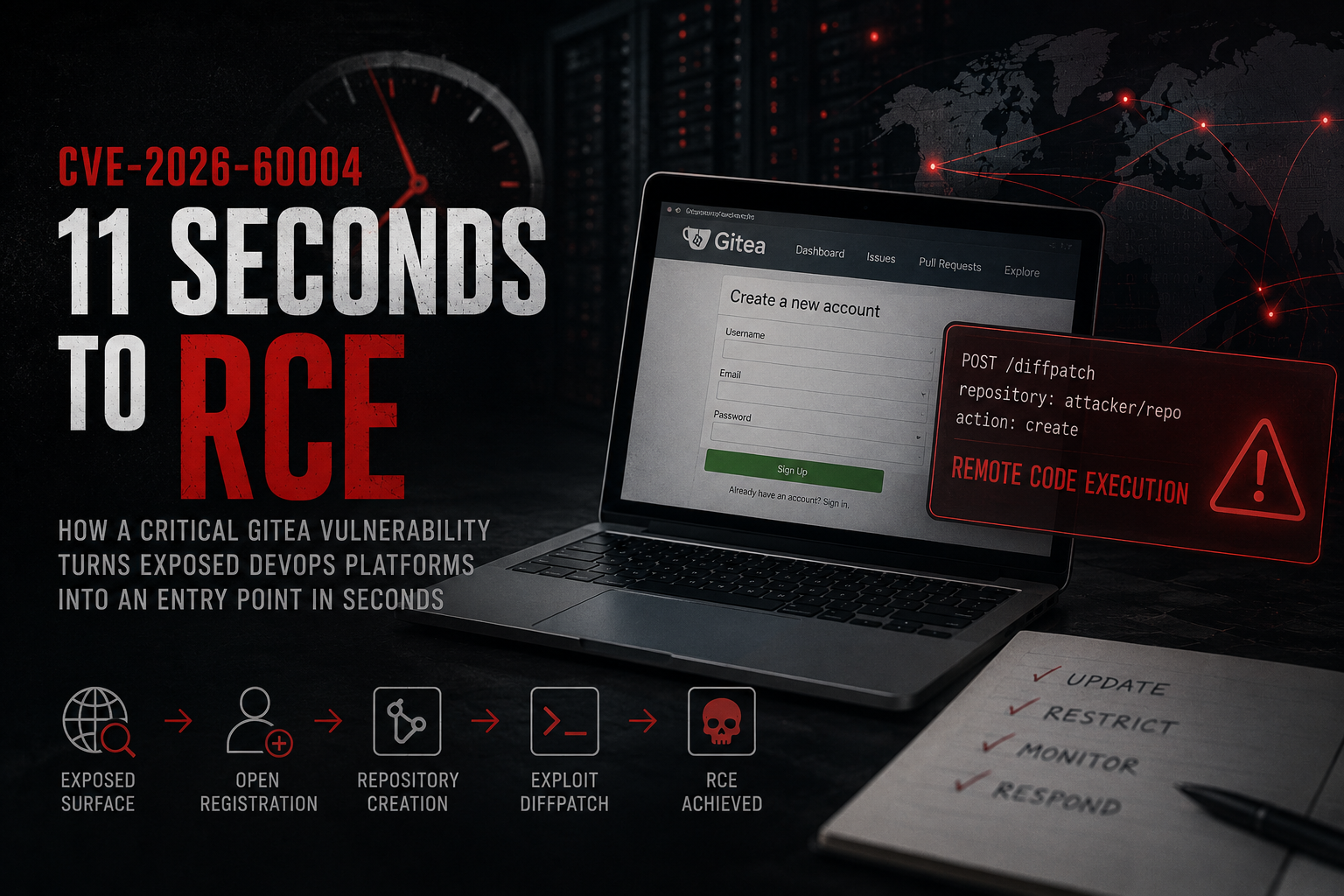
11 Seconds to RCE: What CVE-2026-60004 Teaches Us About Securing Self-Hosted DevOps Infrastructure
11 Seconds to RCE: What CVE-2026-60004 Teaches Us About Securing Self-Hosted DevOps Infrastructure
CVE-2026-60004 demonstrates how a critical software vulnerability, permissive configuration and internet exposure can turn a seemingly ordinary self-hosted development platform into an entry point for compromise within seconds.
On 25 August 2026, the U.S. Cybersecurity and Infrastructure Security Agency added CVE-2026-60004, a critical vulnerability affecting Gitea, to its Known Exploited Vulnerabilities catalogue following evidence of active exploitation.
The vulnerability carries a CVSS 3.1 score of 9.8 and affects Gitea versions 1.17 through 1.27.0. The vulnerability was fixed in Gitea 1.27.1.
However, the vulnerability itself is only one part of the security story.
A publicly documented incident involving an exposed self-hosted Gitea instance showed an automated attack progressing from account registration to remote code execution in approximately 11 seconds. The subsequent activity resulted in the deployment of a cryptomining-oriented payload.
The incident provides an important lesson for security, infrastructure and DevOps teams.
Exposure, configuration, privilege and vulnerability together often determine real-world risk more accurately than a CVSS score alone.
What Is CVE-2026-60004?
CVE-2026-60004 is a remote code execution vulnerability affecting Gitea's diffpatch functionality.
Gitea is a lightweight, open-source Git hosting platform commonly deployed by organisations that want greater control over their source code repositories and development infrastructure.
The vulnerability affects how Gitea processes repository-controlled patches.
According to the Gitea security advisory, the vulnerable diffpatch implementation applies attacker-controlled content inside a temporary bare Git repository.
Under certain conditions, an attacker can cause an executable Git hook to be created inside Git's control directory. Git subsequently executes that hook, resulting in arbitrary command execution under the privileges of the Gitea operating-system service account.
Gitea versions from 1.17 through 1.27.0 are affected.
Gitea 1.27.1 and later contain the fix.
Organisations operating an affected version should upgrade to Gitea 1.27.1 or a newer supported release as soon as possible.
Is It Really a Pre-Authentication RCE?
CVE-2026-60004 has sometimes been described simply as a pre-authentication remote code execution vulnerability.
Technically, however, exploitation requires the attacker to possess write access to a repository.
That distinction is important.
The official Gitea advisory states that an attacker with normal repository write access can execute arbitrary shell commands through the vulnerable functionality.
The situation becomes significantly more dangerous when public user registration is enabled.
An unauthenticated internet user may potentially discover the exposed Gitea service, register a normal account, create a repository, obtain write permission to that repository and then interact with the vulnerable diffpatch functionality.
Authentication therefore technically exists, but a permissive configuration can dramatically reduce the practical value of that authentication boundary.
Open registration is not the vulnerability itself.
It is a risk multiplier.
Even when public registration is disabled, exploitation may remain possible through an existing low-privileged user, a compromised developer account, an insider, a service account or another identity with repository write permissions.
Disabling registration reduces the attack surface, but it does not replace patching.
From Internet Discovery to RCE in Approximately 11 Seconds
One of the most significant aspects of CVE-2026-60004 is the speed demonstrated in a publicly documented real-world compromise.
The affected organisation was operating an outdated self-hosted Gitea deployment.
Public registration was enabled without additional controls such as mandatory e-mail verification.
The malicious activity progressed rapidly.
The attacker accessed the signup functionality, created an account, created a private repository, queried repository information and interacted with the vulnerable diffpatch functionality.
Within approximately 11 seconds, remote code execution had been achieved.
This is an important reality check for organisations operating internet-facing infrastructure.
An attacker does not necessarily need to know who owns the server.
They do not need to understand the organisation's business model.
They do not need to target a specific employee.
An automated attack system may only need to answer three questions.
Is the service exposed?
Is the service vulnerable?
Can the attacker obtain the required permissions?
If all three conditions are satisfied, exploitation can become almost entirely automated.
What Happened After Exploitation?
In the documented attack, code execution occurred inside the Gitea container as the git user.
The subsequent attack chain involved downloading additional components and eventually executing a cryptominer-like payload.
The payload attempted to consume available CPU resources and interfere with competing mining processes.
The compromise became visible when CPU utilisation remained unusually high.
Containerisation limited part of the blast radius.
The container was reportedly not privileged, and the malicious mining process did not survive container restarts.
However, the container still had outbound internet connectivity.
That connectivity allowed additional payloads to be retrieved following the initial compromise.
This highlights an important security principle.
Containerisation reduces risk, but it does not eliminate it.
A compromised application running inside a container may still have access to application configuration, environment variables, database credentials, OAuth credentials, API tokens, repository contents, CI/CD secrets, mounted storage, internal network resources and outbound internet connectivity.
The Gitea security advisory also warns that successful exploitation may expose application secrets, mounted repositories, database credentials, OAuth and integration credentials and other services reachable from the Gitea environment.
Software Supply Chain Exposure
Source-code platforms occupy a highly privileged position within modern enterprise environments.
Compromising a Git platform can provide an attacker with opportunities to access proprietary source code, deployment configurations, infrastructure-as-code repositories, CI/CD workflows, credentials stored inside repositories, package registries, container registries, automation tokens and deployment environments.
What initially appears to be a compromised Git server can therefore become the starting point for a much broader software supply chain compromise.
This is why organisations should not evaluate Git infrastructure as an isolated development tool.
It is often a central part of the organisation's production delivery chain.
Why CVE-2026-60004 Matters Beyond Gitea
The strategic lesson extends beyond Gitea.
Self-hosted infrastructure transfers operational responsibility from a SaaS provider to the organisation operating the service.
With managed SaaS platforms, infrastructure patching and certain operational security responsibilities may be handled by the service provider.
With self-hosted software, asset inventory, patch management, vulnerability monitoring, configuration management, identity governance, network segmentation, telemetry collection, backup and incident response remain the responsibility of the organisation.
This raises a simple but important question.
Who is responsible for knowing that the service exists, that it is exposed and that it requires an urgent security update?
If that responsibility is unclear, the organisation already has a security governance problem.
Five Security Lessons from the Gitea Incident
The first lesson is asset visibility.
Organisations cannot patch infrastructure they do not know exists.
Self-hosted development environments are frequently deployed by infrastructure teams, developers, subsidiaries or individual project groups outside traditional security workflows.
Security teams should maintain visibility into internet-facing services, software versions, service owners, exposure status, business criticality, authentication configuration and patch status.
An unknown Gitea server can quickly become an unmanaged attack surface.
The second lesson is configuration risk.
CVSS provides a useful standardised severity measurement, but it does not represent the entire business context.
For CVE-2026-60004, repository write access is technically required.
Public self-registration can significantly lower that practical barrier.
Security teams should therefore evaluate vulnerabilities using vulnerability severity, internet exposure, configuration, privilege availability, exploit activity and asset criticality together.
The third lesson is least privilege.
Least privilege should apply not only to users but also to applications and workloads.
A Gitea process should not automatically have unrestricted access to sensitive host directories, Docker sockets, management networks, unnecessary internal services or privileged credentials.
When application compromise occurs, architecture determines the size of the blast radius.
The fourth lesson is outbound traffic control.
Security teams often focus heavily on inbound access.
However, post-exploitation activity frequently depends on outbound connectivity.
After obtaining code execution, an attacker may attempt to retrieve additional payloads, communicate with command-and-control infrastructure, exfiltrate data, connect to cryptocurrency mining pools or download additional offensive tooling.
Workloads should therefore have only the outbound connectivity required for their business function.
Restricting unnecessary egress traffic can significantly reduce post-exploitation options.
The fifth lesson is exploit-driven patch management.
Critical internet-facing vulnerabilities cannot always wait for standard monthly or quarterly patch cycles.
When a vulnerability has critical severity, available technical exploitation information, internet-accessible targets and confirmed exploitation, the organisation should move from routine vulnerability management into emergency exposure reduction and incident-readiness mode.
Recommended Actions for Gitea Administrators
Organisations operating Gitea should first identify every Gitea instance in their environment.
This includes production, development, testing and forgotten systems.
For each system, teams should determine its version, owner, business purpose, authentication configuration, external exposure and network reachability.
Systems running Gitea 1.17 through 1.27.0 should be upgraded to version 1.27.1 or a newer supported release.
Perimeter filtering or registration restrictions should not be considered substitutes for patching.
If public self-registration is not a genuine business requirement, it should be disabled.
Organisations should also review e-mail verification, account approval, repository creation permissions, organisation membership, external authentication methods and dormant user accounts.
Repository write permissions should also be reviewed.
Users capable of creating or modifying repositories should be identified, and unnecessary access should be removed.
It is important to remember that disabling public registration does not eliminate the risk from existing compromised accounts.
Security teams should also hunt for evidence of exploitation.
Relevant telemetry may include repeated requests to diffpatch endpoints, unexpected account registrations, newly created repositories, unknown branches, suspicious Git hook files, unusual child processes launched by Gitea, shell activity associated with the Gitea service account, unexpected outbound connections, unexplained CPU utilisation, newly created SSH keys, new access tokens, unfamiliar webhooks and unauthorised repository modifications.
The absence of a single indicator should not automatically be considered evidence that exploitation did not occur.
If compromise is suspected, credentials accessible from the Gitea environment should be identified and rotated.
This may include database passwords, access tokens, OAuth secrets, CI/CD credentials, registry credentials, deployment keys, API tokens and SSH keys.
Updating Gitea removes the vulnerability.
It does not invalidate credentials that may already have been stolen.
Organisations should also review outbound connectivity from the Gitea environment.
Where possible, outbound access should be restricted to required destinations.
Development infrastructure should be segmented from sensitive management networks.
DNS activity and unusual external connections should also be monitored.
Patch, Then Hunt
One of the most common mistakes when responding to an actively exploited vulnerability is assuming that successful patching means the incident is over.
There are two separate questions.
Are we still vulnerable?
Were we already compromised?
Updating Gitea answers the first question.
Only investigation can answer the second.
Internet-accessible systems that remained vulnerable during an active exploitation period should therefore be treated as part of a patch-and-hunt exercise rather than a simple software maintenance task.
The Bigger Question: Who Owns the Exposure?
CVE-2026-60004 illustrates a challenge that extends far beyond Gitea.
Modern organisations operate an expanding collection of source-code platforms, container registries, CI/CD servers, Kubernetes dashboards, monitoring systems, developer portals, administrative interfaces, testing environments and open-source services.
Many of these systems were never intended to become permanently exposed internet assets.
Once exposed, however, automated scanning infrastructure can discover them very quickly.
The security challenge is therefore no longer simply whether an organisation knows about the latest CVE.
The more important questions are whether the organisation knows which vulnerable technologies it operates, where those technologies are exposed, who can access them and what could happen if one of them is compromised.
This is the difference between traditional vulnerability management and continuous exposure management.
Final Thoughts
The most important number associated with this incident may not be the CVSS score of 9.8.
It may be 11 seconds.
Approximately 11 seconds between initial interaction with an exposed service and successful remote code execution demonstrates how compressed modern attack timelines have become.
Security teams cannot realistically compete with automated exploitation using only manual discovery, spreadsheet-based asset inventories and periodic patch meetings.
Self-hosted infrastructure requires continuous ownership.
That means maintaining asset visibility, vulnerability intelligence, secure configuration, least privilege, network segmentation, continuous monitoring and incident response readiness as part of a single security lifecycle.
CVE-2026-60004 should therefore be viewed not simply as another critical vulnerability that needs to be patched.
It is a reminder of a broader principle.
If an organisation chooses to own the infrastructure, it must also own the security lifecycle surrounding that infrastructure.
When exploitation can begin within seconds, visibility and response speed are no longer operational advantages.
They are security requirements.