
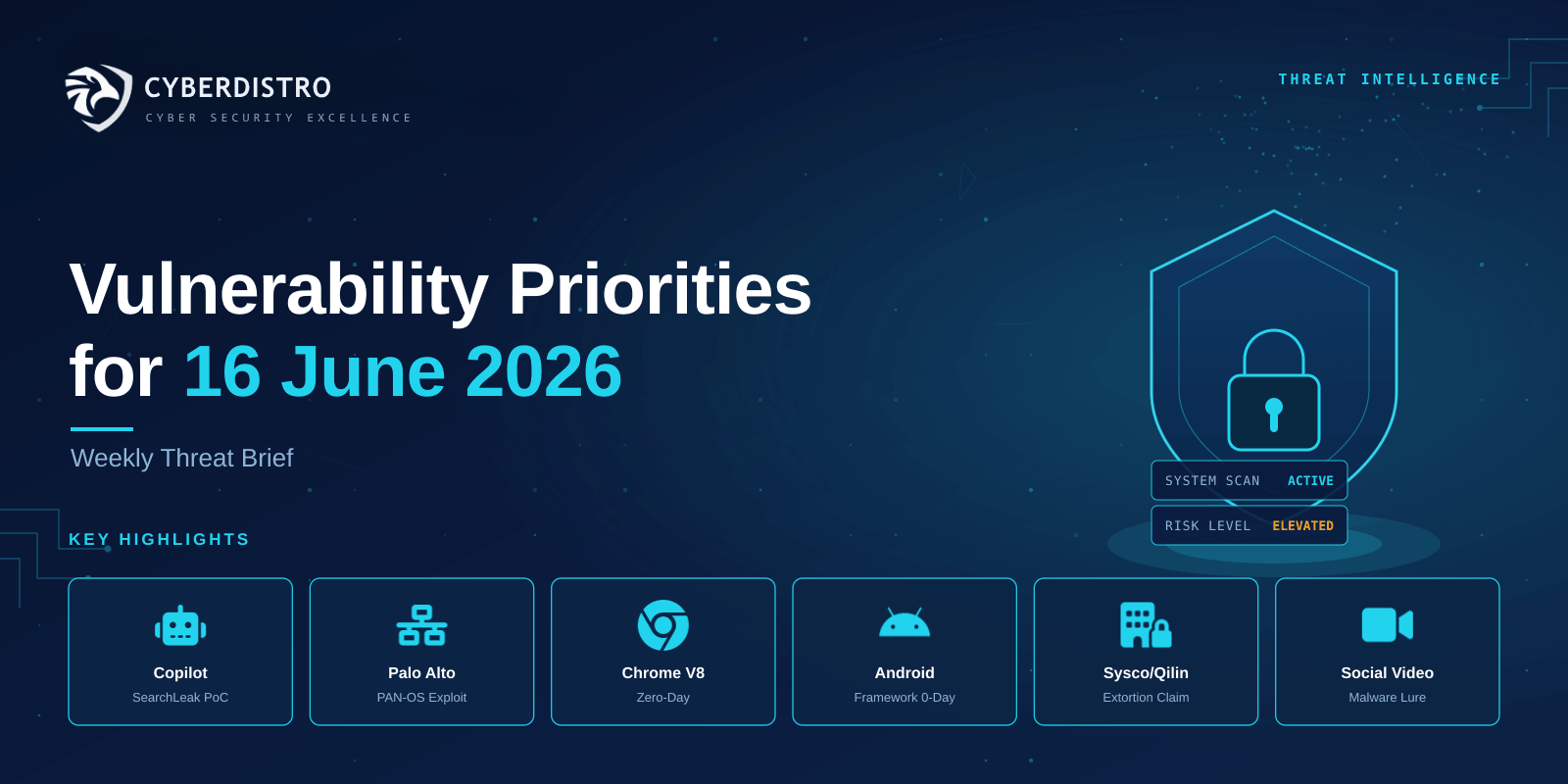
Vulnerability Priorities for 16 June 2026: AI Assistants, the Network Edge, and the Erosion of Trust
CyberDistro Weekly Threat Brief — 16 June 2026
This week's intelligence carries a single, uncomfortable theme: the things enterprises are trained to trust — a microsoft.com link, a VPN gateway, an app update, a video feed — are exactly what is being turned against them. From a one-click data-theft chain inside Microsoft 365 Copilot to actively exploited zero-days in Chrome and Palo Alto's GlobalProtect, the priority this week is not "which CVE has the highest score." It is "which of these is actually being exploited, which assets are exposed, and where is misplaced trust doing the attacker's work?"
Below we break down the six developments that deserve your security team's attention, each rated by its real-world urgency rather than its headline severity.
Executive Summary
Two confirmed, actively exploited flaws sit at the top of this week's list: an authentication bypass in Palo Alto Networks PAN-OS GlobalProtect, and the fifth exploited Chrome zero-day of 2026. Both demand immediate patching. Alongside them, Varonis disclosed "SearchLeak," a critical proof-of-concept chain that quietly turns Microsoft 365 Copilot Enterprise Search into a data-exfiltration engine — a reminder that AI assistants are now a first-class attack surface. Rounding out the week: an actively exploited Android privilege-escalation zero-day (now patched), an unverified extortion claim against food-distribution giant Sysco, and a rising social-engineering trend in which short-form videos lure users into installing malware themselves.
The honest read: this is not a week to react to severity labels. It is a week to separate confirmed exploitation from proof-of-concept, and credible disclosure from attacker marketing.
1. Microsoft 365 Copilot "SearchLeak" — CVE-2026-42824
Status: Proof-of-concept — no observed in-the-wild exploitation. Patched server-side.
The most conceptually significant item this week is not the most urgent — but it may be the most instructive. Researchers at Varonis Threat Labs disclosed a vulnerability they call SearchLeak, a one-click chain that could pull emails, calendar details, security codes, password-reset links, and indexed SharePoint and OneDrive files out of Microsoft 365 Copilot Enterprise Search — with no prompt, no password, and no second click.
What makes SearchLeak important is how it works. It is not a single flaw; it is three individually manageable weaknesses chained so that each one enables the next:
- Parameter-to-Prompt (P2P) Injection. The
qparameter in the Copilot Enterprise Search URL is passed directly to Copilot as an executable prompt. A crafted link can therefore instruct Copilot to search the victim's own mailbox and files. - HTML Rendering Race Condition. During response streaming, an attacker-controlled
<img>tag fires before the output sanitizer has a chance to strip it — embedding the stolen data inside an image URL. - CSP Bypass via Bing SSRF. Because Bing's image-search endpoint is allowlisted in Copilot's Content Security Policy and performs a server-side fetch, the request originates from trusted Microsoft infrastructure. The browser's CSP is irrelevant for a server-side request, so the data sails out to the attacker's endpoint.
The victim sees only "Copilot thinking." No visible data movement occurs.
The crucial detail for prioritization: Microsoft assigned CVE-2026-42824 a "critical" label, but the CVSS scores were notably lower and disagreed — 6.5 from Microsoft's own advisory versus 7.5 from the National Vulnerability Database. More importantly, Microsoft fully remediated the issue on its backend at the start of June, and Varonis published only a proof-of-concept. There is no evidence of exploitation in the wild, and because Copilot Enterprise is a managed service, no customer action is required to receive the fix.
So why does it matter? Because the pattern is the payload. SSRF and HTML-sanitizer race conditions are old, well-understood bug classes. The new ingredient — prompt injection — makes them reachable again, and turns a trusted AI assistant into an exfiltration channel. This is the second time Varonis has demonstrated the technique against Copilot (after the earlier "Reprompt" work), and it echoes the 2025 "EchoLeak" zero-click Copilot flaw. The lesson is that AI assistants must now be treated as a data-egress surface in their own right.
What you can do: Tenant admins cannot patch a managed service, but they can watch and contain. Monitor Copilot Search URLs for encoded payloads or HTML in the q parameter, audit CSP allowlists for domains that perform server-side fetches on user-supplied input, and fold AI-assistant access into your data-loss-monitoring scope.
2. Palo Alto Networks PAN-OS GlobalProtect Authentication Bypass — CVE-2026-0257
Status: Actively exploited. CISA KEV-listed. Patch immediately.
This is the week's most operationally urgent item. CVE-2026-0257 is an authentication-bypass flaw in the GlobalProtect portal and gateway components of Palo Alto Networks PAN-OS, allowing an attacker to bypass security restrictions and establish an unauthorized VPN connection straight into the corporate network.
The severity story here is itself a lesson in honest risk assessment. Palo Alto initially rated the flaw medium — its CVSS v4 base score was 4.7 — because exploitation requires a specific configuration. Rapid7 disagreed from the outset, arguing that an authentication bypass on an internet-facing VPN appliance, where success lands an attacker inside the network, is not a medium-severity problem regardless of what the calculator says. Real-world events vindicated that view: Palo Alto raised the score to 7.8 and confirmed active exploitation, and CISA added the flaw to its Known Exploited Vulnerabilities catalog with a federal remediation deadline of 1 June 2026.
Rapid7 documented two distinct attack waves — the first from 18 May originating on Vultr-hosted infrastructure, and a second from 21 May — in which attackers used forged authentication-override cookies targeting local administrator accounts to authenticate to GlobalProtect gateways and establish unauthorized VPN tunnels. No lateral movement was observed from compromised devices, but the attackers achieved network-level access equivalent to any authenticated VPN user — a foothold for reconnaissance and staging.
Exposure is specific: the issue affects deployments where GlobalProtect Portal or Gateway is enabled, Authentication Override Cookies are enabled, and a vulnerable certificate configuration exists. A common misconfiguration — reusing the same certificate for both the HTTPS service and cookie encryption — lets an attacker grab the public key straight from the HTTPS session. Panorama and Cloud NGFW are not affected.
What you can do: Upgrade to the fixed version for your PAN-OS branch now; standard perimeter defenses will likely miss the intrusion because, to the system, the attacker looks like a legitimate user. If you cannot patch immediately, disable Authentication Override on the portal and gateway, or generate a new certificate used only for authentication-override cookies — never reused from the portal or gateway certificate. Review GlobalProtect logs for the IOCs published in Rapid7's advisory. Coming on the heels of last week's Check Point VPN issue, this confirms the network edge as the season's favourite ransomware front door.
3. Google Chrome V8 Zero-Day — CVE-2026-11645
Status: Actively exploited zero-day. Patched. Update and restart now.
Google patched CVE-2026-11645, an out-of-bounds memory access flaw in Chrome's V8 JavaScript engine, and confirmed that an exploit exists in the wild. As is typical for an actively exploited browser bug, Google disclosed little beyond the bare technical details to give users time to update.
The number that matters: this is the fifth actively exploited Chrome zero-day of 2026 — and we are not yet halfway through the year. In prior years, five exploited browser zero-days represented roughly a full year's worth of activity. The acceleration reflects both a healthy bug-bounty pipeline and a sophisticated market for browser exploits.
What you can do: Browser auto-update is not optional, and the patch only takes effect after a restart — so track restart-pending devices and enforce managed-update compliance. The browser remains one of the most heavily targeted endpoints in any environment.
4. Android June Security Update — CVE-2025-48595
Status: Actively exploited zero-day. Patch available; rollout varies by vendor.
Google's June Android update addressed 124 vulnerabilities, including one actively exploited zero-day. CVE-2025-48595 is an integer-overflow flaw in the Android Framework — the set of APIs and system services apps interact with directly — that lets a local attacker with basic application permissions escalate privileges without any user interaction.
The operational wrinkle is the rollout gap. Pixel devices receive the fix immediately through Google's delivery system, while Samsung, Xiaomi, OnePlus and other manufacturers push updates on rolling timelines that can extend for weeks. That means a meaningful window of exposure across a mixed corporate fleet.
What you can do: Enforce a minimum patch level (2026-06-05) through MDM policy for devices that access sensitive corporate applications, and monitor your MDM console for unusual privilege-escalation events. Treat the patch-level gap between Pixel and other vendors as a real, time-bound risk, not a formality.
5. Sysco / Qilin — Extortion Claim
Status: Unconfirmed attacker claim. Verify before reacting.
The Qilin ransomware group has tied an alleged breach of food-distribution giant Sysco to a second extortion demand, reportedly involving around 61 million records. As of reporting, Sysco had not publicly confirmed a breach or disclosed any operational impact.
This item is on the list precisely because it is unverified. Big-name extortion claims are a deliberate pressure tactic, and they drive copycat fear and premature, unfocused response across entire sectors. The figures circulating are the attacker's claim — not an established fact — and should be treated as such until independently corroborated.
What you can do: If Sysco is part of your supply chain, monitor the situation through official channels and your own threat intelligence, but resist reacting to attacker-supplied numbers. Use the moment to review your third-party incident-response playbooks and data-exposure assumptions — calmly, and on evidence.
6. Short-Form Video Malware Lures — TikTok & Instagram Reels
Status: Trend to watch. User awareness is the primary control.
Attackers are increasingly using short-form video platforms like TikTok and Instagram Reels to spread malware. The lures are slick clips promising free Spotify Premium, free Windows activation, or free Microsoft Office. The twist is that there is no exploit involved — victims are talked into installing the malware themselves.
This is the same self-install playbook used by fake-update information-stealers such as OnyxC2, which we covered separately this week. The shift away from traditional phishing email toward social-media-native lures means the threat reaches users in contexts your email gateway never sees.
What you can do: "Free premium" is bait. Reinforce a clear policy that software is installed only from official vendor sites or managed channels, and make short-form-video lures an explicit part of security-awareness training. On managed devices, application allowlisting and behaviour-based endpoint detection close the gap that signatures and email filters leave open.
Why It Matters: Critical Is Not the Same as Exploited
If there is one takeaway from this week, it is that a "critical" label and "actively exploited" are not the same thing — and conflating them wastes the response capacity you need for the threats that are actually live.
- PAN-OS GlobalProtect and Chrome V8 are confirmed, in-the-wild exploitation. They are the fire alarms. Patch first.
- SearchLeak is a critical-labelled proof-of-concept that Microsoft already fixed. Its value is strategic: it tells you where to look next, not what to panic about today.
- Android is an exploited zero-day with a patch available but an uneven rollout — a known, time-bound risk to manage through MDM.
- Sysco/Qilin is an unverified claim — a reason to watch and verify, not to react.
- Video malware lures are a behavioural trend best countered by awareness and allowlisting.
The connective tissue across all six is the erosion of trust signals. A real microsoft.com link, a legitimate VPN portal, a signed app update, a familiar social feed — each is being used precisely because it is trusted. Effective defense in this environment depends less on blocking known-bad signatures and more on validating behaviour, narrowing exposure at the edge, and confirming what is genuinely being exploited.
First 24-Hour Action Plan
Inventory → prioritize confirmed exploitation → patch → hunt → harden the human layer.
- Verify PAN-OS portal/gateway versions and review GlobalProtect access; upgrade affected branches immediately.
- Hunt VPN and edge logs for anomalous authentication and session establishment; check Rapid7's published IOCs.
- Update Chrome to the latest build and track restart-pending devices to ensure the patch is actually applied.
- Enforce a minimum Android patch level (2026-06-05) across the fleet via MDM.
- Confirm Microsoft's backend mitigation status for M365 Copilot and add AI-assistant access to data-loss monitoring.
- Monitor the Sysco/Qilin situation for genuine supply-chain impact — without reacting to attacker-supplied figures.
- Remind users that "free premium" video offers are malware bait, and reinforce official-source-only software installation.
Monitoring & Detection Focus
This week's success criterion is not simply updating — it is verifying impact and watching behaviour rather than signatures. Closure should be measured across edge session and authentication telemetry, browser and mobile update compliance, AI-assistant access policy, user-awareness reinforcement, and exposure validation for any unconfirmed claims. EDR, SIEM, vulnerability-scanner output, and edge logs should be unified into a single remediation view, so that confirmed exploitation is closed first and proof-of-concept findings are tracked without diverting urgent capacity.
This brief was prepared by CyberDistro for security leaders, architects, and practitioners. It is intended for cybersecurity awareness and vulnerability prioritization. Severity ratings reflect real-world exploitation status as of 16 June 2026 and may change as new intelligence emerges.
Sources: Varonis Threat Labs; Microsoft MSRC; The Hacker News; BleepingComputer; Dark Reading; SC Media; Palo Alto Networks Security Advisories; Rapid7; Unit 42; CISA Known Exploited Vulnerabilities Catalog; Google Chrome Releases; Android Security Bulletin (June 2026); SecurityWeek; BlackFog.