
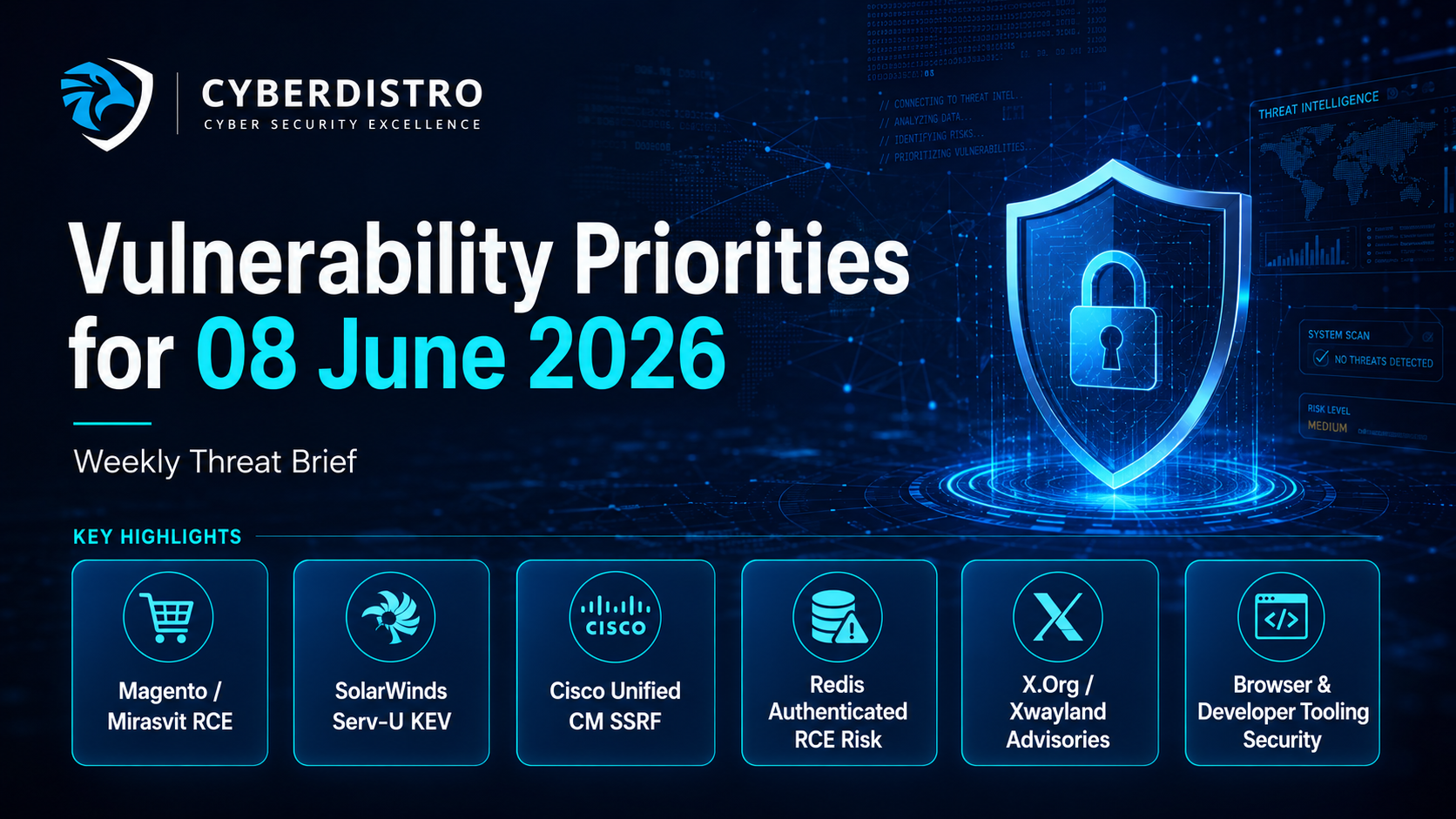
CyberDistro Weekly Threat Brief: Vulnerability Priorities for 08 June 2026
For security teams, the key message for the week of 08 June 2026 is clear: critical vulnerability management can no longer be driven only by the question, “Which CVE has the highest CVSS score?”
This week’s vulnerability landscape highlights the need to assess multiple risk layers together, including externally exposed web and e-commerce systems, managed file transfer infrastructure, unified communications platforms, Redis services, Linux graphical components, browser security, and developer tooling risks.
Vulnerabilities with active exploitation signals or entries in the CISA Known Exploited Vulnerabilities (KEV) catalogue require rapid validation, patching, log hunting, and clear remediation ownership. The operational priority is not only to apply patches, but to understand which assets are exposed, which services support business-critical workflows, which systems may provide access to credentials or production environments, and whether the risk has been demonstrably closed.
1. Web and E-commerce Layer: Magento/Mirasvit RCE Risk
One of the most critical issues this week is CVE-2026-45247, affecting Mirasvit Full Page Cache Warmer for Magento 2.
According to NVD, versions prior to 1.11.12 are affected by an unauthenticated PHP object injection vulnerability. Attackers may exploit the issue through a crafted CacheWarmer cookie, potentially leading to remote code execution.
Sansec’s analysis indicates that the vulnerability can be triggered through storefront requests, does not require an admin session or special configuration, and may lead to RCE when a suitable gadget chain is present.
This vulnerability is particularly important for e-commerce environments. Platforms such as Magento and Adobe Commerce are directly connected to customer data, payment processes, order workflows, and brand trust. A vulnerable plugin with RCE impact is therefore not only an application security issue, but also a business continuity and data protection concern.
Recommended Actions
- Upgrade Mirasvit Cache Warmer to version 1.11.12 or later.
-
Search web logs for suspicious requests containing the
CacheWarmercookie. -
Review
pub/and other web-accessible directories for unexpected PHP files. - Build and validate a complete Magento/Adobe Commerce plugin inventory.
- Correlate WAF, EDR, and web server logs during investigation.
2. File Transfer and MFT Infrastructure: SolarWinds Serv-U KEV Activity
CVE-2026-28318 affecting SolarWinds Serv-U is another important item for this week.
NVD describes the issue as an unauthenticated vulnerability that can be triggered by specially crafted POST requests using Content-Encoding: deflate, potentially causing the Serv-U service to crash. The vulnerability is rated High and has been added to the CISA KEV catalogue.
Although this issue is not categorized as remote code execution, its business impact should not be underestimated. Managed file transfer systems such as Serv-U are often used for supplier integrations, customer file exchange, financial data transfer, operational reporting, and partner workflows.
A successful attack may therefore result in direct operational disruption.
Recommended Actions
- Validate the installed SolarWinds Serv-U version and hotfix level.
- Confirm whether Serv-U is exposed to the internet.
- Monitor for abnormal POST requests and resource consumption events.
- Strengthen availability monitoring and log correlation for MFT services.
- Apply vendor-recommended mitigations and restrict access where patching is delayed.
3. Unified Communications Risk: Cisco Unified CM SSRF
CVE-2026-20230 affects Cisco Unified Communications Manager and Cisco Unified CM SME when the WebDialer service is enabled.
Cisco’s advisory describes the issue as an SSRF vulnerability. NVD notes that successful exploitation may contribute to a chain that could result in elevated privileges. It is also important to note that WebDialer is disabled by default.
Unified communications platforms are often central to enterprise voice, call routing, IP telephony, conferencing, contact centre operations, and internal communications. As a result, vulnerabilities in these systems can impact not only infrastructure security but also business communication continuity.
Recommended Actions
- Review Cisco Unified CM and Unified CM SME version levels.
- Verify whether WebDialer is enabled.
- Disable WebDialer if it is not required.
- Restrict management and service access to trusted source IP ranges.
- Review UC logs for SSRF attempts, abnormal HTTP activity, and unexpected file-write behaviour.
4. Redis Services: Authenticated RCE Exposure
CVE-2026-23479 affects Redis and introduces risk through an authenticated use-after-free condition.
NVD indicates that Redis versions from 7.2.0 up to versions prior to 8.6.3 may be affected. The vulnerability occurs in specific blocked-client flows where certain error paths are not handled correctly, potentially leading to remote code execution by an authenticated attacker.
Redis is commonly used for caching, session storage, queues, rate limiting, job processing, and performance-critical application workflows. If Redis is exposed externally or operated with weak ACL controls, the impact can be severe.
Recommended Actions
- Upgrade Redis to version 8.6.3 or later.
- Confirm that Redis is not internet-facing.
- Review Redis ACLs and enforce least privilege.
- Separate application users and permissions.
- Monitor Redis logs for abnormal commands, unexpected connections, and unusual authentication activity.
5. Linux Workstations, VDI, and Graphical Components: X.Org / Xwayland Updates
In early June, X.Org published multiple security advisories affecting X.Org X Server and Xwayland.
The affected versions include X.Org X Server prior to 21.1.23 and Xwayland prior to 24.1.12. The vulnerabilities include stack-based buffer overflow, use-after-free, out-of-bounds read/write, and information disclosure issues.
This topic is particularly relevant for Linux workstations, VDI environments, kiosks, jump servers, bastion hosts, and servers using graphical interfaces. Graphical components may sometimes be deprioritized in patching workflows, but in multi-user or remote desktop environments, the attack surface can become more significant.
Recommended Actions
- Upgrade X.Org X Server packages to 21.1.23 or later.
- Upgrade Xwayland packages to 24.1.12 or later.
- Include Linux workstation and VDI images in patch planning.
- Review local privilege escalation risk on jump servers and bastion hosts.
- Track distribution-specific advisories and package updates.
6. Browser Security: Firefox and Chrome Update Discipline
Browsers remain one of the most critical user-side attack surfaces.
Mozilla released Firefox 151.0.3, addressing two high-impact vulnerabilities: CVE-2026-10701 and CVE-2026-10702. Chrome also received multiple vulnerability advisories during the 08 June week.
For enterprises, the key issue is not only whether an update has been released, but whether the update has been successfully deployed across managed endpoints. Restart-pending devices, unmanaged browsers, and high-risk browser extensions can all weaken security posture.
Recommended Actions
- Track Chrome/Chromium and Firefox version compliance centrally.
- Report restart-pending endpoints separately.
- Validate managed browser policies and auto-update configuration.
- Review browser extension inventory and remove high-risk extensions.
- Correlate phishing, drive-by download, and token theft scenarios with endpoint telemetry.
7. Developer Tooling and Credential Exposure
Developer tooling is another important security area this week.
VS Code, github.dev, browser-based development workflows, and OAuth-based access models should now be assessed beyond traditional endpoint security. Developer tools often have direct access to repositories, tokens, SSH keys, GitHub OAuth scopes, CI/CD pipelines, and cloud credentials.
A vulnerability or token theft scenario in a developer tool may therefore have a much broader impact than a single compromised workstation. In many environments, the developer workstation functions as a gateway into source code, build pipelines, and production systems.
Recommended Actions
- Review GitHub OAuth applications and permission scopes.
- Minimize the use of personal access tokens.
- Apply least privilege to token scopes.
- Build a VS Code extension inventory.
- Improve session isolation for browser-based development environments.
- Automate secret scanning and commit history reviews.
First 24-Hour Action Plan
For this week, CyberDistro recommends a five-step response plan.
1. Inventory
Identify affected assets across Magento/Mirasvit, SolarWinds Serv-U, Cisco Unified CM, Redis, X.Org/Xwayland, Chrome, Firefox, and developer tooling environments.
2. Validate Exposure
Confirm which systems are internet-facing, which services are reachable outside trusted networks, and which assets support critical business workflows.
3. Apply Patches
Deploy vendor-recommended updates and hotfixes. Where immediate patching is not possible, apply temporary hardening and access restrictions.
4. Perform Log Hunting
Search for CacheWarmer cookie indicators in Magento logs, abnormal POST requests in Serv-U logs, unexpected WebDialer or HTTP behaviour in Cisco Unified CM, and abnormal Redis command or connection activity.
5. Reduce Credential Risk
Review developer tokens, SSH keys, GitHub OAuth permissions, CI/CD secrets, and cloud credentials. Rotate credentials where exposure is suspected or cannot be ruled out.
Monitoring and Detection Recommendations
This week’s success criterion is not simply “the system has been updated.” Security teams must be able to prove closure.
Monitoring, EDR, SIEM, vulnerability scanners, and asset inventory data should be combined into a single remediation visibility layer.
Key metrics to track include:
- External exposure status of critical services
- Patch level and version compliance
- Number of restart-pending endpoints
- Abnormal web request volume
- Serv-U availability and resource consumption
- Redis connection and command behaviour
- Developer token and OAuth application changes
- Exception records and risk acceptance status
For organizations using PRTG, a practical monitoring approach may include custom sensors, REST sensors, and log-based checks to track critical service availability, version status, patch SLA violations, service crashes, HTTP response anomalies, and endpoint update compliance from a single dashboard.
Strategic Takeaway
The week of 08 June 2026 reinforces three important points for vulnerability management programmes.
First, e-commerce and web plugins can create direct RCE-level business risk.
Second, MFT and file transfer services are not only technical infrastructure components; they are critical to business continuity.
Third, developer tooling and browser security must now be managed together with credential security and source-code protection.
Modern vulnerability management should therefore bring together patch management, exposure management, detection engineering, credential governance, and executive-level risk ownership under a unified operational model.
Conclusion
This week’s priority is not only to focus on the highest-scoring CVEs. Security teams should evaluate real business impact, exposure, active exploitation signals, and remediation capacity together.
For critical systems, successful closure should answer four questions clearly:
- Is the system externally exposed?
- Is the affected version actually in use?
- Are there exploitation attempts or anomalies visible in the logs?
- Has patching, mitigation, credential rotation, and exception ownership been validated?
CyberDistro’s recommendation for this week is clear: manage vulnerability prioritization not only through technical scores, but through exposure, business impact, credential risk, and operational evidence.
Sources
- NVD – CVE-2026-45247 Mirasvit Full Page Cache Warmer
- Sansec – Critical Vulnerability in Mirasvit Cache Warmer for Magento
- NVD – CVE-2026-28318 SolarWinds Serv-U
- Cisco Security Advisory – Cisco Unified Communications Manager SSRF
- X.Org Security Advisories
- NVD – CVE-2026-23479 Redis
- Mozilla Security Advisory – Firefox 151.0.3