
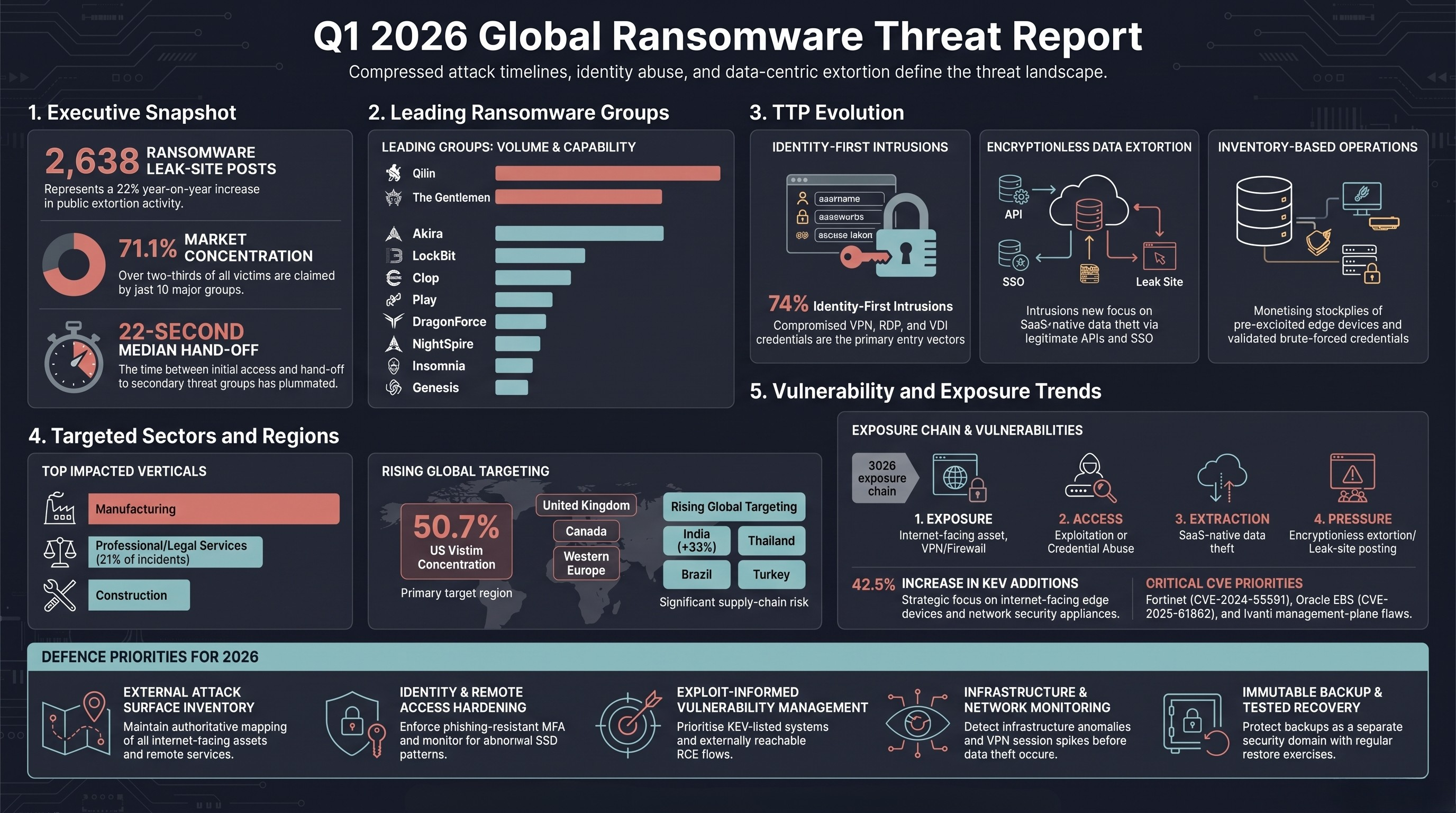
Q1 2026 Global Ransomware Threat Report
Executive Summary
Q1 2026 confirmed that ransomware has moved into a more consolidated, data-driven operating model. Public datasets vary because each vendor counts victims, leak-site posts and confirmed incidents differently, but the signal is consistent: ransomware activity remained at an elevated baseline. Check Point recorded 2,122 data leak site victims in Q1 2026, GuidePoint reported 2,135 publicly posted victims across 68 active groups, CyberMaxx reported 2,282 ransomware attacks and 69 active groups, while ReliaQuest counted 2,638 ransomware leak-site posts, a 22% year-on-year increase from Q1 2025. These are not contradictory figures; they show a high-volume extortion market measured through different intelligence lenses.
The most important development was not raw volume, but concentration. Check Point assessed that the top 10 ransomware groups accounted for 71.1% of all publicly posted victims, with Qilin, Akira, The Gentlemen and LockBit representing 41% of victims. Qilin remained the leading operation by public victim volume, while The Gentlemen emerged as the breakout actor of the quarter and LockBit 5.0 showed signs of renewed activity after prior law-enforcement disruption.
The operational tempo is also compressing. Mandiant’s M-Trends 2026 reporting shows that the median time between initial access and hand-off to a secondary threat group has fallen to 22 seconds, while CrowdStrike reported average eCrime breakout time at 29 minutes, with the fastest observed breakout occurring in 27 seconds. For enterprise defenders, this changes the response model: a low-severity malware alert, suspicious VPN login or abnormal SaaS export can no longer be treated as a routine queue item. It may be the first visible trace of a high-impact extortion chain.
Evolution of Threat Actor TTPs
The first shift is reconsolidation. After the fragmentation of 2024 and 2025, Q1 2026 showed a return to fewer but stronger ransomware brands. This benefits mature RaaS operators because they can absorb experienced affiliates, standardise tooling, control negotiation infrastructure and maintain more credible leak sites. For victims, the practical effect is a higher likelihood of facing disciplined operators rather than short-lived crews with inconsistent tooling.
The second shift is pre-positioned access. The Gentlemen is the clearest example. Check Point reported that the group’s rise was linked to a reported stockpile of approximately 14,700 pre-exploited FortiGate devices and 969 validated brute-forced FortiGate VPN credentials, largely associated with CVE-2024-55591 exploitation. This is not opportunistic scanning in the traditional sense. It is inventory-based ransomware operations: access is prepared, validated and later monetised at scale.
The third shift is encryptionless extortion. Beazley observed multiple Q1 ransomware intrusions where actors exfiltrated data without encrypting systems, reducing technical complexity while still creating legal, reputational and commercial pressure. This model is especially effective against organisations holding regulated data, client files, intellectual property or sensitive contractual records.
Identity-first intrusion is now a primary operating lane. Beazley reported that compromised remote access credentials, combined with VPN, RDP and VDI exposure, accounted for 74% of ransomware intrusions investigated in Q1. ReliaQuest also highlighted ShinyHunters-style SaaS-native extortion, where attackers abuse identity workflows, SSO, MFA enrolment and cloud platforms such as Salesforce and SharePoint to extract data through legitimate APIs and bulk downloads.
Data leak site operations became noisier and more fragmented. ReliaQuest counted 91 active leak sites in Q1 2026, a record in its dataset. This matters because incident response teams now have to validate claims quickly, distinguish real compromise from fabricated pressure tactics, and manage legal, regulatory and communication workflows under public exposure pressure.
AI-assisted operations are a developing accelerator, not the root cause of most ransomware incidents. Mandiant’s M-Trends 2026 still ties most successful intrusions to systemic security failures, including exploited services, prior compromise and weak identity control. Google Threat Intelligence Group did, however, report threat actor use of AI for vulnerability discovery, exploit development, malware support and autonomous command generation. The sensible reading is balanced: AI is compressing attacker workflows, but exposed services, weak credentials, poor telemetry and slow response remain the real business risk.
Targeted Sectors & Regional Impacts
Manufacturing remained one of the most exposed sectors. GuidePoint assessed manufacturing as the most impacted industry in Q1 2026, where Qilin, Akira and The Gentlemen were among the leading actors. CyberMaxx also identified technology and manufacturing as top-targeted industries. The reason is straightforward: production downtime is expensive, IT/OT environments are often complex, and recovery pressure is high.
Professional services and legal services also carried heavy exposure. Beazley observed professional services as the most targeted sector in its Q1 incident dataset, representing 21% of observed ransomware incidents. ReliaQuest reported that professional, scientific and technical services remained the most targeted sector for the fourth consecutive quarter, with posts increasing from 736 in Q4 2025 to 840 in Q1 2026. Law firms, consultants, accountants and engineering firms are valuable extortion targets because one breach can expose many clients at once.
Construction continued to rise as a structural target rather than a temporary outlier. GuidePoint assessed that construction would remain among the five most impacted verticals into Q2 2026, with distributed pressure from Qilin, Play, DragonForce, Akira and Clop. The sector’s exposure is driven by contractor ecosystems, shared project environments, document repositories, remote access dependencies and high downtime sensitivity.
Healthcare remained materially exposed, even where some datasets showed a lower share of observed incidents. GuidePoint reported disproportionate healthcare impact from newer groups such as Insomnia and Genesis alongside Qilin, while Beazley observed healthcare falling from 15% to 10% of its incident distribution. That should not be read as reduced risk. Healthcare still combines operational urgency, sensitive personal data and a low tolerance for downtime.
Geographically, the United States remained the primary ransomware target. GuidePoint recorded 1,084 US victims, equal to 50.77% of its Q1 dataset, followed by the United Kingdom and Canada at 4.12% each. Check Point’s dataset showed a similar pattern, with the United States accounting for 49.6% of reported cases.
Western Europe continued to appear heavily in victim datasets, particularly the United Kingdom, France, Germany and Italy. At the same time, Q1 showed stronger signals from APAC and Latin America. Thailand entered GuidePoint’s top 10 for the first time, while Brazil and India remained present in the top 10. ReliaQuest also noted a 33% rise in India-based targeting, which has supply-chain implications for organisations with outsourced IT, manufacturing dependencies or regional subsidiaries.
For Turkey and nearby regional markets, the key takeaway is that ransomware risk can no longer be framed as a US-centric issue. Check Point reported that LockBit 5.0’s Q1 2026 victim distribution included Turkey at 5.1% of the group’s total, alongside Italy and Brazil. This does not make Turkey a top global victim country, but it does indicate that renewed and geographically diversified RaaS operations are touching regional enterprise environments.
Vulnerability Exploitation Trends
Q1 2026 reinforced the strategic value of edge devices. Firewalls, VPN gateways, remote access appliances, mobile device management platforms and internet-facing enterprise applications remain attractive because they sit at the boundary of identity, access and internal network trust. Beazley reported 15,243 new CVEs in Q1, 40 additions to CISA’s Known Exploited Vulnerabilities catalogue, and a 42.9% quarter-on-quarter increase in KEV additions. More than half of that KEV increase related to edge devices such as firewalls and VPN endpoints.
CVE-2024-55591, affecting Fortinet FortiOS and FortiProxy, was one of the most important ransomware-relevant vulnerabilities in Q1 reporting. Check Point linked The Gentlemen’s growth to pre-compromised FortiGate access, while GuidePoint reported NightSpire gaining initial access through CVE-2024-55591. In both cases, the vulnerability illustrates a wider pattern: ransomware actors are not only exploiting new bugs; they are also monetising previously compromised infrastructure long after initial exploitation.
Oracle E-Business Suite exploitation continued to influence Q1 victim reporting. CrowdStrike tracked a mass exploitation campaign targeting Oracle EBS via CVE-2025-61882 for data exfiltration, while Oracle confirmed that the vulnerability was remotely exploitable without authentication and could result in remote code execution. GuidePoint noted that Clop continued to claim victims in Q1 2026 even though exfiltration activity occurred during late 2025, matching Clop’s established pattern of delayed mass-extortion posting.
Mandiant and GTIG assessed that the Oracle EBS campaign followed months of intrusion activity, with suspected exploitation as early as August 2025 and extortion activity later targeting executives. This is a highly relevant pattern for defenders: breach discovery may occur weeks or months after exploitation, and the first clear business signal may be an extortion email rather than an endpoint alert.
Ivanti and mobile management platforms also remained part of the wider Q1 exploitation picture. Beazley reported critical Ivanti Endpoint Manager Mobile and Endpoint Manager vulnerabilities in Q1, with EPMM flaws actively exploited in the wild and linked by Rapid7 to Iranian state-affiliated activity. While not every such campaign becomes ransomware, the same exposed management-plane weaknesses can support ransomware access, destructive activity and data theft.
Government guidance moved in the same direction. CISA issued Binding Operational Directive 26-02 in February 2026 to mitigate risk from end-of-support edge devices, and public reporting on the directive notes that CISA described internet-facing edge devices such as firewalls, routers, switches, wireless access points, network security appliances and IoT edge devices as high-risk when they no longer receive security updates.
Strategic Recommendations
Ransomware resilience in 2026 is an architecture and operations problem, not a single-tool procurement exercise. The defensive model should assume that at least one identity, SaaS application, remote access service or edge appliance will be targeted during the year.
First, prioritise external attack surface governance. Maintain an authoritative inventory of internet-facing assets, including VPNs, firewalls, MDM systems, load balancers, SaaS portals, exposed APIs and remote administration services. Map each asset to ownership, business function, patch status, firmware status and end-of-support date. Unsupported edge devices should be removed or replaced through a tracked lifecycle plan, not left as “temporary” infrastructure.
Second, harden identity and remote access. Enforce phishing-resistant MFA for privileged accounts and remote access, remove stale VPN and RDP accounts, restrict administrative access by source, and apply conditional access policies for high-risk SaaS platforms. Monitor rapid password resets, new MFA device enrolment, impossible travel, unusual SSO patterns and bulk SaaS exports.
Third, treat early-stage alerts as possible ransomware precursors. Malware detections, suspicious browser updates, abnormal PowerShell execution, unauthorised remote tools, failed VPN bursts and unusual RDP/SMB patterns should be correlated, not handled in isolation. Mandiant’s 22-second hand-off finding means SOC teams need event correlation, not linear ticket handling.
Fourth, build visibility across infrastructure, not only endpoints. EDR and SIEM are necessary, but ransomware often reveals itself through infrastructure anomalies before encryption begins: VPN session spikes, unusual NetFlow patterns, backup job failures, replication errors, storage growth, unexpected service restarts, probe loss, domain controller load, and sudden changes in critical service availability. Continuous network, server and application monitoring gives security and infrastructure teams a shared operational picture during containment.
Fifth, protect backups as a separate security domain. Backups should be immutable or offline, protected with separate credentials, monitored for job integrity and tested through regular restore exercises. The NCSC’s current guidance continues to emphasise that organisations need reliable backups for operational data and should verify that backups can be restored; it also advises protecting online backups with two-step verification.
Sixth, isolate high-value management planes. Virtualisation platforms, backup consoles, directory services, MDM tools, EDR management, PAM systems and cloud administration portals must be segmented and monitored as privileged infrastructure. Attackers increasingly target these layers because control of the management plane can accelerate both disruption and recovery denial.
Seventh, shift vulnerability management from CVSS-only prioritisation to exploit-informed prioritisation. Internet-facing KEV-listed systems, externally reachable RCE flaws, authentication bypass issues, VPN/firewall vulnerabilities and enterprise application zero-days should be patched or mitigated ahead of lower-risk internal findings. The patch queue should reflect adversary behaviour, not only scanner severity.
Eighth, prepare for data theft without encryption. Legal, compliance, communications, executive leadership and security operations teams should have a pre-approved workflow for extortion-only incidents. This includes data scoping, evidence preservation, regulator notification, customer communication, cyber insurance coordination and third-party legal support.
Ninth, validate third-party exposure. Professional services, legal providers, outsourced IT, MSPs, construction partners and regional suppliers should be assessed for remote access controls, breach notification terms, privileged access pathways and data handling practices. A supplier’s ransomware incident can become your data exposure.
Finally, run realistic exercises. Tabletop scenarios should include SaaS data theft, compromised VPN credentials, Fortinet or Ivanti-style edge exploitation, Oracle EBS-style enterprise application compromise, ESXi encryption, backup deletion and public leak-site pressure. The objective is not to rehearse a perfect response. It is to identify where decision-making, monitoring, access control and recovery will fail under pressure, then fix those gaps before a real incident does it for you.