
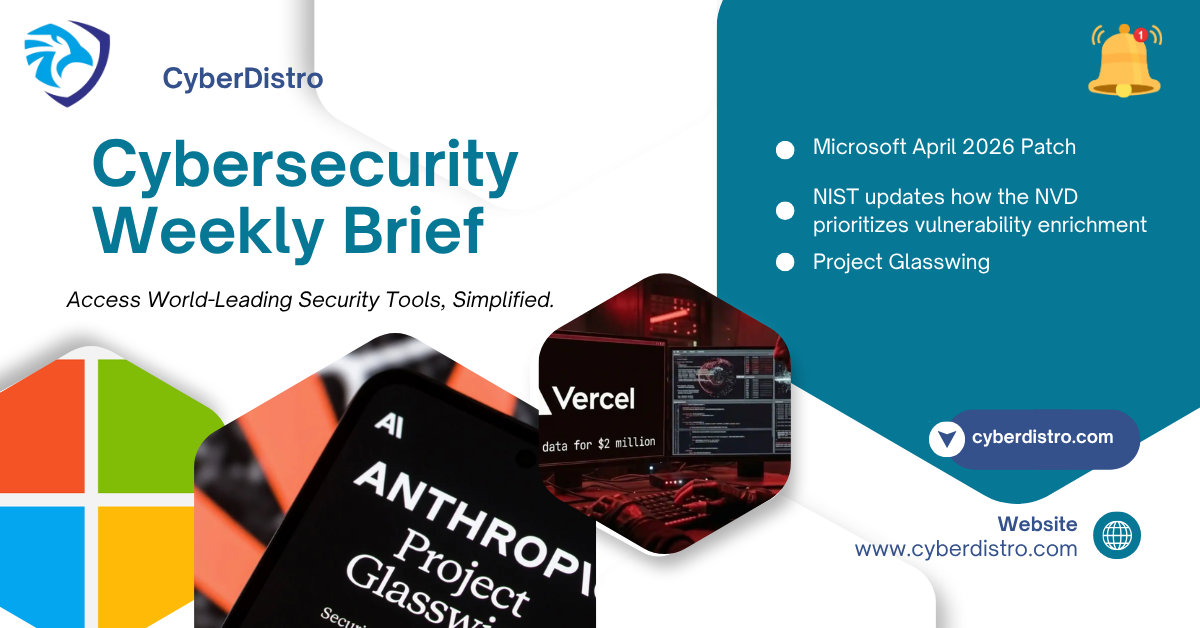
CyberDistro Weekly
CyberDistro Weekly
Issue — April 2026
— — —
1) Vercel discloses a platform security incident: what teams should do now
Category: Incident Watch | Read time: 3 min
Vercel has confirmed a security incident affecting components of its hosting and deployment platform. The company is coordinating remediation, rotating affected credentials, and publishing ongoing updates through its official status and trust channels.
Because Vercel sits directly in the build-and-deploy path for many modern web applications, the exposure surface for customers is broader than a single product. Tokens, environment variables, Git integrations, preview environments, serverless functions, and authorized third-party apps all run through the platform, and any of them could become relevant depending on final incident scope.
For engineering and security teams, the near-term priorities are straightforward:
· Review all active Vercel access tokens and service accounts. Rotate anything that could plausibly be in scope.
· Audit environment variables for long-lived secrets (API keys, database credentials, third-party tokens) and rotate high-value ones.
· Re-check authorized OAuth integrations on connected Git providers and SaaS tools.
· Confirm that production deployment approvals and protected environments are gated by identity controls you trust.
· Monitor Vercel's status and trust pages for updated guidance, then apply the specific remediation steps they publish.
Operational takeaways
· Treat this as a credential rotation event until Vercel's final guidance narrows the scope.
· Prioritize secrets with production blast radius first: database, cloud provider, and payment/identity APIs.
· Document what you rotated and when — it shortens the next audit cycle considerably.
Primary source: Vercel Status & Trust Center — https://vercel-status.com/
— — —
2) Microsoft April 2026 Patch Tuesday: one of the heaviest cycles in recent memory
Category: Patch & Exposure Priorities | Read time: 3 min
Microsoft's April 2026 Patch Tuesday addresses a broad set of vulnerabilities across Windows kernel components, Office, Exchange, SQL Server, Azure, and developer tooling. It lands as one of the largest recent release cycles, with multiple items on internet-exposed and identity-adjacent surfaces — the fast-path concerns for patch prioritization.
Volume alone is not the signal. The actionable questions this month are narrower: which items are flagged as exploitation detected or more likely, which affect remotely reachable services, and which touch the identity and authentication plane.
Most programs will get the best return from a tiered approach:
· Tier 1 — 72 hours. Items with active exploitation, server-side remote code execution, or authentication bypass on exposed services (Exchange, SQL, remote management, VPN/edge).
· Tier 2 — 7–14 days. Kernel-level elevation of privilege, Office and browser engine issues reachable via common delivery paths.
· Tier 3 — standard cycle. Lower-severity client-side and tooling issues, bundled into normal monthly rollout waves.
Before broad deployment, validate this month's updates against recent Windows servicing regressions in a representative ring. Large cycles amplify both patch value and rollout risk.
Operational takeaways
· Lead with exploitation signals, not raw CVE counts.
· Prioritize server-side RCE and identity-plane fixes over client-side bulk.
· Keep a pre-prod ring that mirrors your real workloads — it pays for itself on heavy months like this one.
Primary source: Microsoft Security Response Center — Update Guide — https://msrc.microsoft.com/update-guide/
— — —
3) NIST updates how the NVD prioritizes vulnerability enrichment
Category: Policy Shift | Read time: 3 min
NIST has revised the prioritization framework used to enrich incoming CVE records in the National Vulnerability Database. The updated approach weights exploitation signals, vendor impact, and ecosystem reach so that higher-risk vulnerabilities receive CVSS, CPE, and CWE enrichment ahead of lower-priority entries.
For downstream programs, the practical effect is that NVD enrichment timing is now uneven by design. A subset of vulnerabilities — typically the most impactful ones — will be enriched quickly. Many others will land with partial metadata for longer than security teams have historically expected.
Vulnerability management tooling that assumes a fully populated NVD record before scoring or ticketing will feel this first. The more durable pattern is a blended intake:
· NVD for authoritative CVE records and core enrichment where available.
· Vendor advisories for first-party impact, affected versions, and remediation detail.
· CISA KEV for confirmed, real-world exploitation.
· EPSS for exploitation likelihood over the near term.
Treated together, these give a more stable risk signal than any single feed.
Operational takeaways
· Stop treating NVD enrichment completeness as a gate for action.
· Ingest vendor advisories, KEV, and EPSS in parallel with NVD.
· Re-check how your scanner, SIEM, and ticketing pipelines react to partially enriched CVE records.
Primary source: NIST National Vulnerability Database — https://nvd.nist.gov/
— — —
4) Project Glasswing and the shift toward model integrity in AI security
Category: AI Security Spotlight | Read time: 3 min
Project Glasswing is part of a broader shift in AI security away from prompt-layer filtering and toward deeper controls on the model itself: provenance, weight integrity, training data lineage, and runtime attestation for inference workloads.
The reason is structural. Prompt filters address the top of the stack but leave the parts of an AI system that actually determine behavior — the weights, the serving pipeline, the data that shaped them — largely unverified. For regulated environments and high-trust deployments, that gap is becoming untenable.
Three questions are moving from "nice to have" to procurement table stakes:
· Provenance. Can you attest that the model weights in production match what was approved and signed off?
· Lineage. Can you trace training and fine-tuning data back to controlled, governed sources?
· Runtime integrity. Can you detect tampering in the serving path — not just in the prompt — while models are in use?
Expect these controls to surface in enterprise AI contracts, vendor questionnaires, and internal AI governance policies through 2026. Teams that can already answer the three questions above will move faster when those requirements arrive.
Operational takeaways
· Inventory AI systems the same way you inventory software: version, source, owner, and risk tier.
· Require signed model artifacts and verified serving images for production AI workloads.
· Treat AI supply chain (models, data, fine-tuning) as part of the broader software supply chain, not a separate program.
— — —