
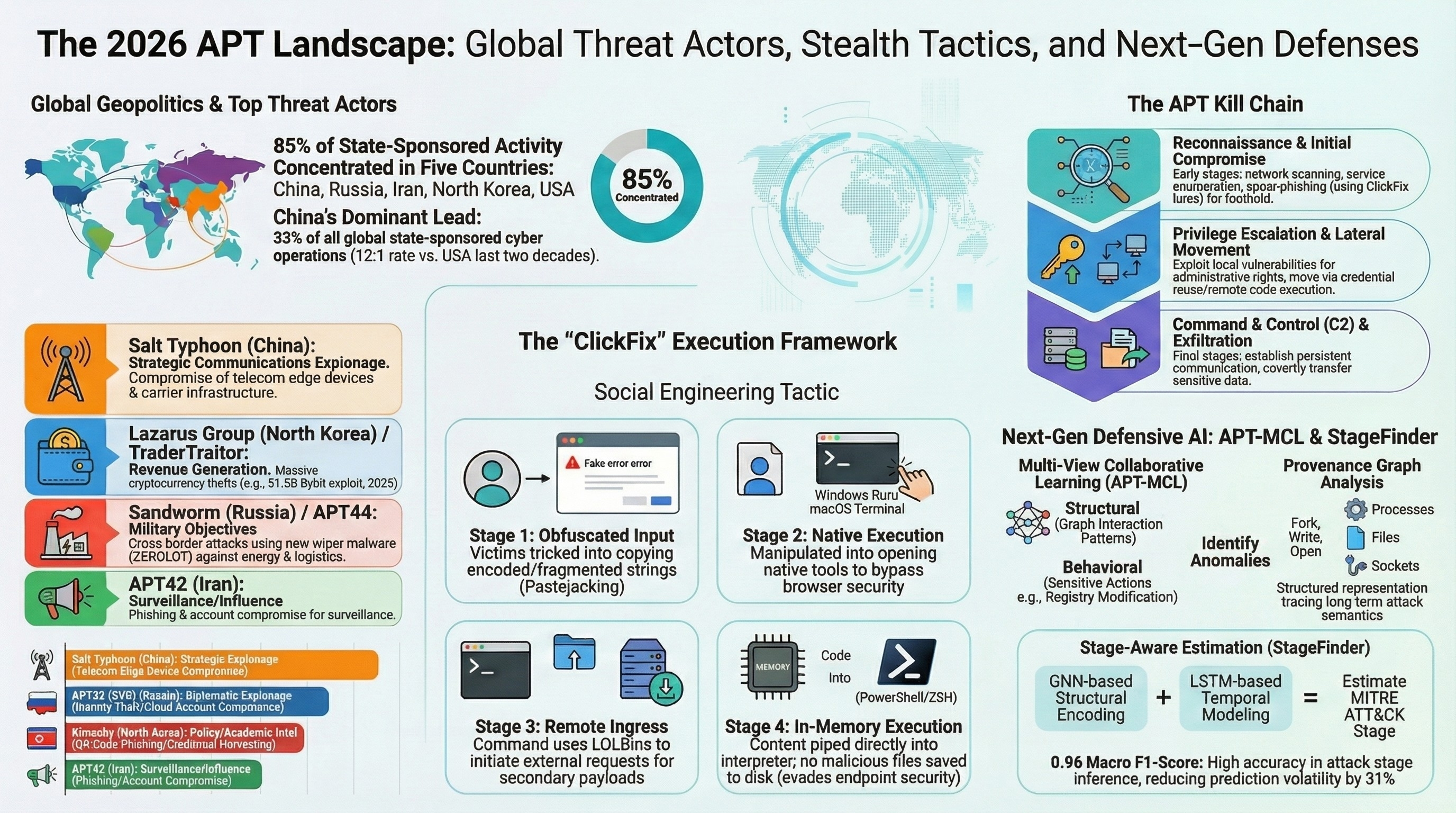
The Most Impactful APT Campaigns of 2026: The Exploitation of Trust
As of 2026, a clear shift is emerging across the cyber threat landscape.
APT groups are no longer focused solely on compromising systems; they are systematically targeting trust relationships, identity layers, and the software ecosystem itself.
The most prominent campaigns this year demonstrate a move away from traditional attack models toward identity-driven, supply chain-oriented, and low-visibility operations.
UNC2814 – Stealth-Driven Cloud Espionage
The China-linked UNC2814 group stood out with its large-scale GRIDTIDE operations.
The group leverages legitimate services such as Google Sheets APIs to mask command-and-control communications, significantly reducing detection surface.
Key characteristics:
- C2 communication via legitimate SaaS platforms
- Long-term access targeting telecom and government sectors
- Stealth-first operational model
UNC6201 – Targeting Infrastructure and Virtualization Layers
UNC6201 focuses on edge devices and virtualization infrastructure to deepen its foothold within target environments.
By exploiting zero-day vulnerabilities, the group achieves persistence and lateral movement with high efficiency.
Key characteristics:
- Targeting appliances and VMware environments
- Use of zero-day exploits
- Advanced lateral movement techniques
Lotus Blossom – Supply Chain Manipulation
Lotus Blossom demonstrated how sophisticated supply chain attacks have become by compromising software update mechanisms and delivering malicious payloads to selected targets.
Key characteristics:
- Exploitation of software update infrastructure
- Selective and targeted payload delivery
- Focus on critical infrastructure and government entities
APT28 – Rapid Exploit Weaponization
The Russia-linked APT28 continues to operate with high efficiency by rapidly weaponizing newly discovered vulnerabilities, particularly in geopolitically sensitive regions.
Key characteristics:
- Fast exploit operationalization
- Regional targeting (notably Eastern Europe)
- Email and data-centric espionage
MuddyWater (Boggy Serpens) – Trust-Based Intrusions
Rather than relying purely on technical exploitation, this Iran-linked group focuses on abusing trust relationships.
By leveraging compromised accounts, attackers gain access through legitimate-looking interactions.
Key characteristics:
- Use of hijacked accounts
- Living-off-the-land techniques
- Targeting energy, finance, and critical sectors
DPRK APT Ecosystem – Identity-Driven Infiltration
North Korea-linked actors have introduced one of the most distinct approaches in 2026.
By combining fake identities, developer targeting, and AI-assisted social engineering, they infiltrate organizations through hiring processes and development workflows.
Key characteristics:
- Fake IT worker operations
- Developer ecosystem infiltration
- Credential and access-focused attacks
Conclusion
APT campaigns in 2026 highlight a critical reality:
Attackers are no longer targeting systems they are targeting trust.
This shift requires a fundamental change in security strategy. Organizations must move beyond endpoint-centric defenses and prioritize:
- Identity and access visibility
- Supply chain risk management
- Behavioral and session-level monitoring
Without this transition, attackers can operate within environments without ever triggering traditional security controls.