
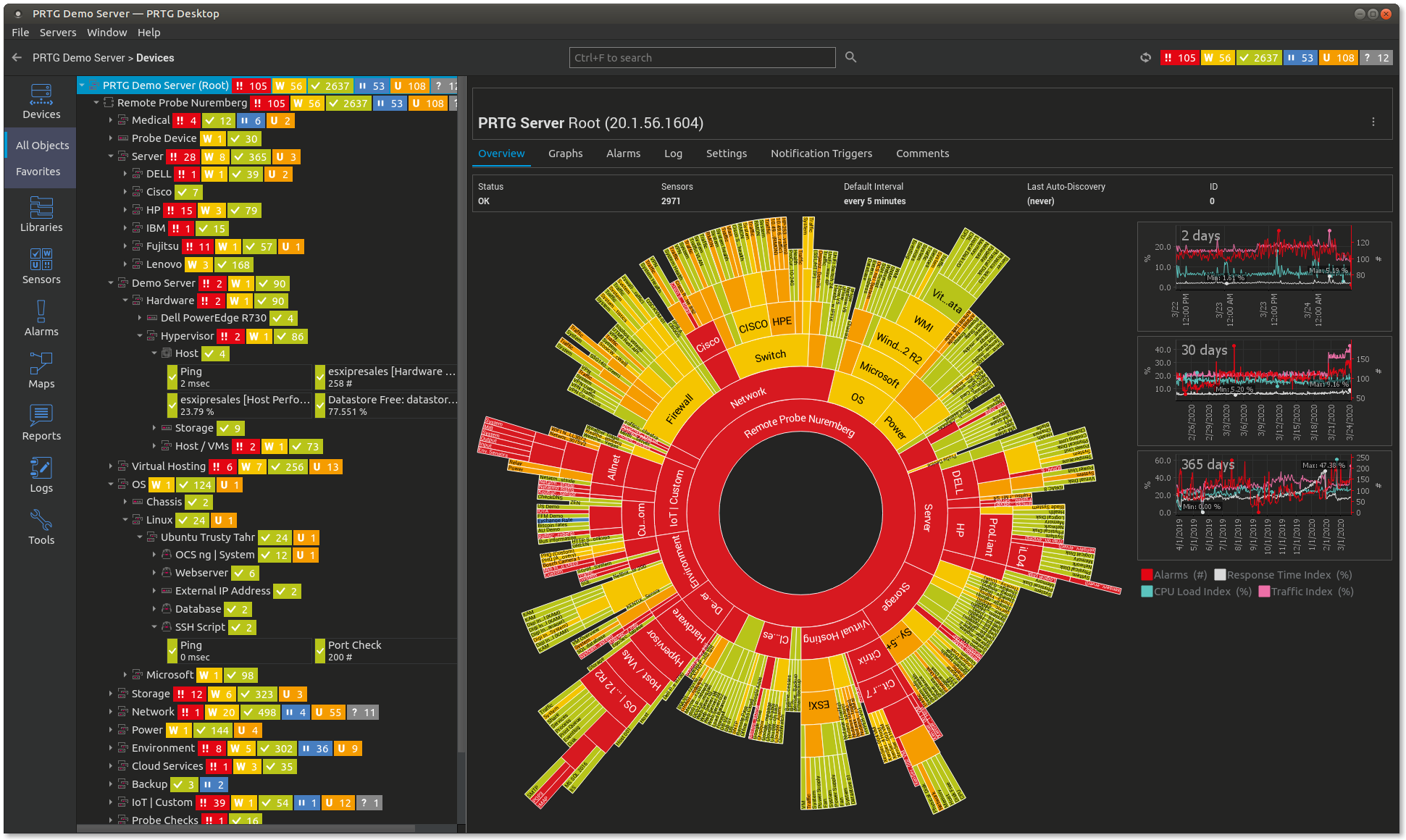
Monitoring Linux Servers with PRTG: A Practical Approach for Modern IT Environments
In modern IT infrastructures, Linux servers power many of the most critical services—from web applications and databases to enterprise platforms and backend systems. Ensuring their performance, availability, and security requires continuous monitoring. PRTG Network Monitor provides a powerful and centralized solution that enables IT teams to monitor Linux and Unix systems efficiently across complex environments.
A Scalable Monitoring Architecture
PRTG is designed with a flexible and scalable architecture suitable for enterprise environments. A typical deployment includes a PRTG Core Server, which acts as the central monitoring engine, and Remote Probes distributed across different network segments.
This distributed architecture allows organizations to monitor infrastructure located in multiple data centers, campuses, or DMZ networks while maintaining centralized visibility and control. By placing probes close to monitored systems, organizations can improve performance and reduce network overhead.
Monitoring Linux Servers with SSH and SNMP
PRTG supports several protocols for monitoring Linux systems, with SSH and SNMP being the most commonly used.
SSH (Secure Shell)
SSH-based sensors allow PRTG to execute commands directly on Linux systems and retrieve detailed system metrics. These sensors are particularly useful for monitoring:
-
CPU load and system health
-
Memory utilization
-
Disk usage and inode statistics
-
Process counts and uptime
-
Custom application or service metrics via scripts
SNMP (Simple Network Management Protocol)
SNMP is lightweight and efficient, making it ideal for monitoring network-related metrics. It is commonly used to track:
-
Network interface traffic
-
Packet errors and discards
-
Basic system statistics
A widely recommended best practice is to use SSH for detailed system monitoring and SNMP for network interface and traffic monitoring.
Preparing Linux Systems for Secure Monitoring
Before integrating Linux servers into a monitoring environment, several security and configuration steps are recommended.
One key best practice is creating a dedicated monitoring user, typically named something like prtgmon, with limited privileges. Access should be restricted to SSH key-based authentication, while password-based logins are disabled to reduce security risks.
This approach ensures that monitoring activities remain controlled, secure, and standardized across the infrastructure.
Leveraging PRTG Sensors for Deep Visibility
PRTG offers a rich set of built-in sensors designed specifically for Linux environments. Some commonly used sensors include:
-
SSH Load Average Sensor – monitors CPU load
-
SSH MemInfo Sensor – tracks memory utilization
-
SSH Disk Free Sensor – monitors disk capacity
-
SNMP Traffic Sensor – analyzes network traffic
-
SSH Script Advanced Sensor – enables custom monitoring scripts
These sensors provide deep insight into both system performance and application-level metrics.
Conclusion
Proactive monitoring is essential for maintaining reliable Linux-based infrastructures. With its agentless architecture, extensive sensor library, and support for standard protocols such as SSH and SNMP, PRTG Network Monitor offers IT teams a powerful way to gain complete visibility into their Linux environments.
By implementing a properly configured PRTG monitoring strategy, organizations can:
-
Detect performance issues before they impact services
-
Gain real-time insight into system health
-
Improve capacity planning and operational efficiency
-
Ensure the availability of critical business systems
For organizations running Linux workloads, PRTG provides a scalable and efficient monitoring platform that simplifies infrastructure management while enhancing operational resilience.