
IoT, AI, and Cloud: Not Separate Technologies, but a Unified Risk Chain
Introduction
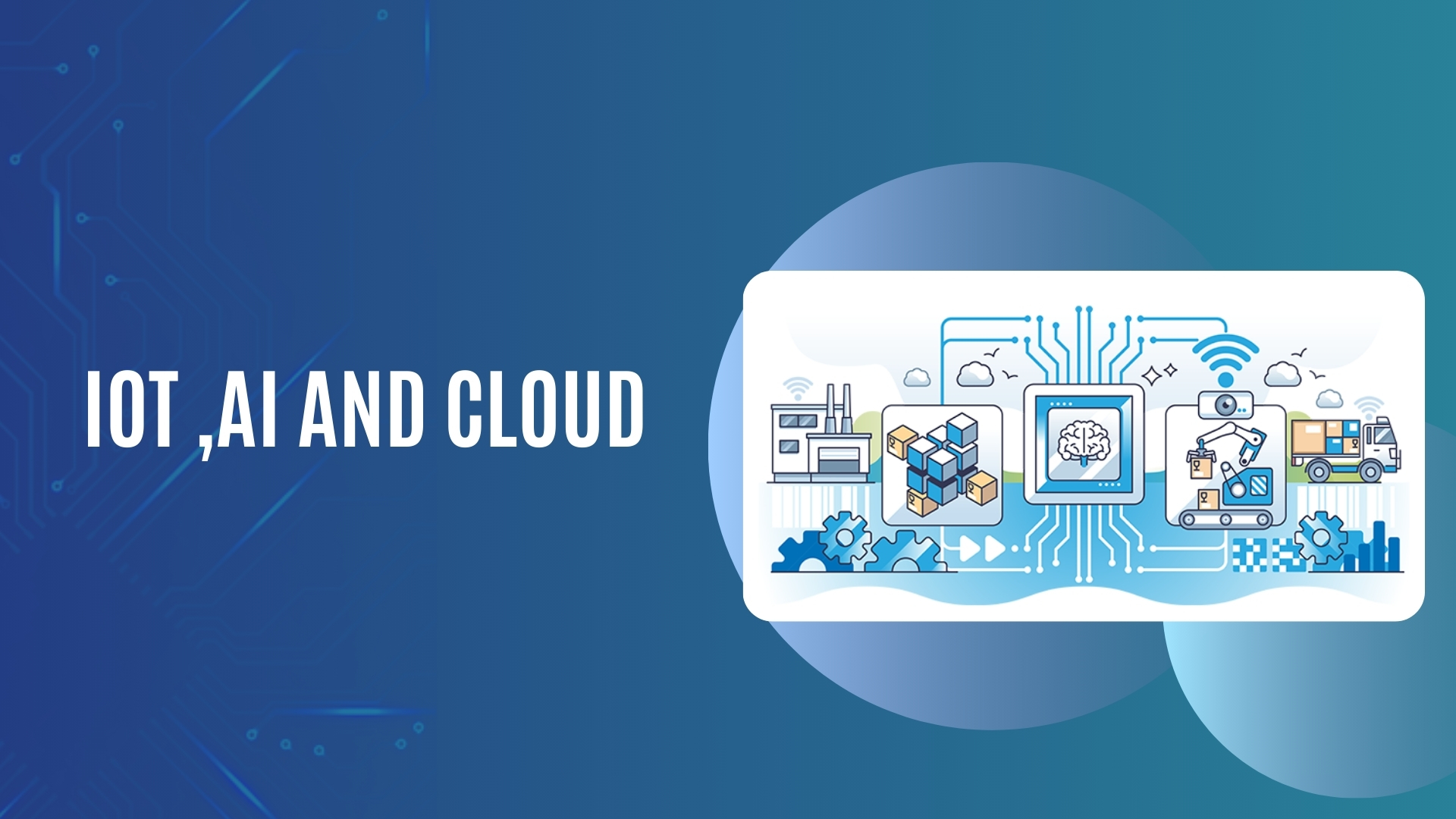
IoT, AI, and Cloud are often discussed as independent technology domains. In modern system architectures, however, this separation no longer holds. IoT is not meaningful in isolation; it depends on cloud infrastructure to aggregate and process data, and on AI layers to extract decisions from that data. Likewise, AI systems are ineffective without continuous, high-volume data streams, and cloud platforms have become the de facto execution and concentration layer for both data and decision logic.
This enforced convergence introduces a new class of cybersecurity risk. Risk no longer originates from a single device, application, or service. Instead, it emerges across the architectural chain that links data generation, data concentration, and automated decision-making. This article deliberately avoids future projections and speculative scenarios. It focuses on architectural realities that are already observable in production systems today, and on the security failures that arise directly from those realities.
Architectural Perspective: The Chain Itself Is the Attack Surface
The IoT layer is, by nature, a source of continuous and inherently untrusted data. Sensors are physically exposed, computationally constrained, and frequently deployed with long operational lifecycles. Firmware updates are sporadic, identity mechanisms are weak, and environmental exposure is unavoidable. The data produced at this layer is raw, context-poor, and highly susceptible to manipulation.
The cloud layer acts as the point of aggregation, normalization, and scaling. Data is not merely stored; it is enriched, correlated with other sources, and transformed into forms suitable for automated processing. Centralization enables efficiency and elasticity, but it also creates architectural concentration.
The AI layer has evolved from an analytical component into an active decision engine. It generates alerts, triggers automation, alters system behavior, and increasingly operates with minimal human intervention. As a result, every decision produced by AI is structurally dependent on the integrity of the preceding layers.
This architecture does not create isolated attack surfaces. It creates a chained attack surface. A weakness at one layer does not remain local; it propagates upward, often amplifying its impact as it moves closer to the decision layer.
Security Failures at the Convergence Points
Manipulation of IoT-originated data is one of the most subtle and effective attack vectors in this architecture. Small, systematic distortions in sensor output can lead AI models to normalize incorrect behavior as legitimate. These failures are rarely flagged as security incidents; they manifest instead as unexplained or degraded system behavior and may persist undetected for extended periods.
Centralized AI services deployed in cloud environments introduce architectural single points of failure. While redundancy may exist at the infrastructure level, the decision logic itself is often shared. Disruption or compromise of inference services, data pipelines, or orchestration layers can simultaneously affect multiple operational domains.
APIs, telemetry pipelines, inference endpoints, and orchestration mechanisms form the natural attack surface of this combined architecture. Each component may appear secure in isolation. When evaluated as a chain, however, a weakness at any point can influence or fully control downstream decision-making.
Currently Observed Risk Patterns
Model poisoning and data poisoning are no longer theoretical constructs. Manipulated training data or corrupted live inference inputs can permanently alter model behavior without interrupting system availability. From an operational perspective, the system continues to function; from a security perspective, it has been subverted.
Violations of IoT telemetry integrity are routinely observed, particularly in industrial, environmental, and critical infrastructure monitoring systems. Because sensor data is often implicitly trusted, higher-level anomaly detection mechanisms fail to trigger.
Cloud misconfiguration remains a dominant risk factor for AI services. Ambiguous authorization boundaries, over-privileged service identities, and poorly constrained model access paths directly expand the attack surface.
IoT device identity, trust chain continuity, and lifecycle management issues undermine the entire architecture. When a system cannot reliably establish what a device is, what code it is running, or whether its state can be trusted over time, higher-layer security controls lose their effectiveness.
These observations align closely with the risk characterizations found in NIST’s AI Risk Management Framework, ENISA’s AI threat landscape analyses, MITRE ATLAS, IEC 62443, and multiple IEEE and arXiv studies on AIoT security. Importantly, they are also consistent with real-world system behavior rather than hypothetical models.
The Evolution of Cybersecurity Approaches
Traditional perimeter-based security and product-centric defenses are insufficient for this architecture. An attacker does not need to breach a boundary when manipulating data, influencing a model, or exploiting orchestration logic can achieve the same outcome.
Risk no longer resides primarily in devices or applications. It emerges across the end-to-end decision chain. Securing individual components without understanding their role in that chain creates a false sense of resilience.
As a consequence, security research in this domain must become inherently interdisciplinary. AI security analysis that ignores IoT realities is incomplete. Cloud security assessments that fail to account for decision automation miss critical failure modes.
Security Research and Analysis Methodology
Threat modeling for combined IoT, AI, and Cloud architectures must extend beyond asset-centric approaches. The primary assets are not only systems, but also data flows and decision outputs.
Security researchers must shift from asking “How can this system be compromised?” to “How can this system be induced to make the wrong decision?” This requires simultaneous analysis of data integrity, model behavior, and execution context.
Risk assessment that isolates devices, data, or AI logic cannot capture systemic failure modes. Only by evaluating system behavior, data provenance, and decision authority together can meaningful security conclusions be drawn.
This perspective is increasingly reflected in cloud security threat models, AI adversarial research, and emerging AIoT security literature.
Conclusion
The convergence of IoT, AI, and Cloud is not a future trend. It is the current architectural baseline of modern systems. The security risks that arise from this convergence are not speculative; they are observable outcomes of how these systems operate today.
Attempting to secure each layer independently is no longer sufficient. Security must encompass the entire decision-making pipeline. Systems that appear operationally healthy can still be producing incorrect or manipulated decisions. This silent failure mode represents one of the most critical challenges in contemporary cybersecurity architecture.